

S.
What ends up on the list
Steps appear in the order you need them, and each one is a thing you can finish on the spot.
Two nodes for the same service ask once. A WhatsApp trigger and the WhatsApp node the agent replies through are one account, so Setup merges them into a single step and connecting it covers both.
The rail on the left groups steps by node and tracks progress. Click any step to jump to it; the finale never counts toward the progress number, since it is a destination rather than a debt.
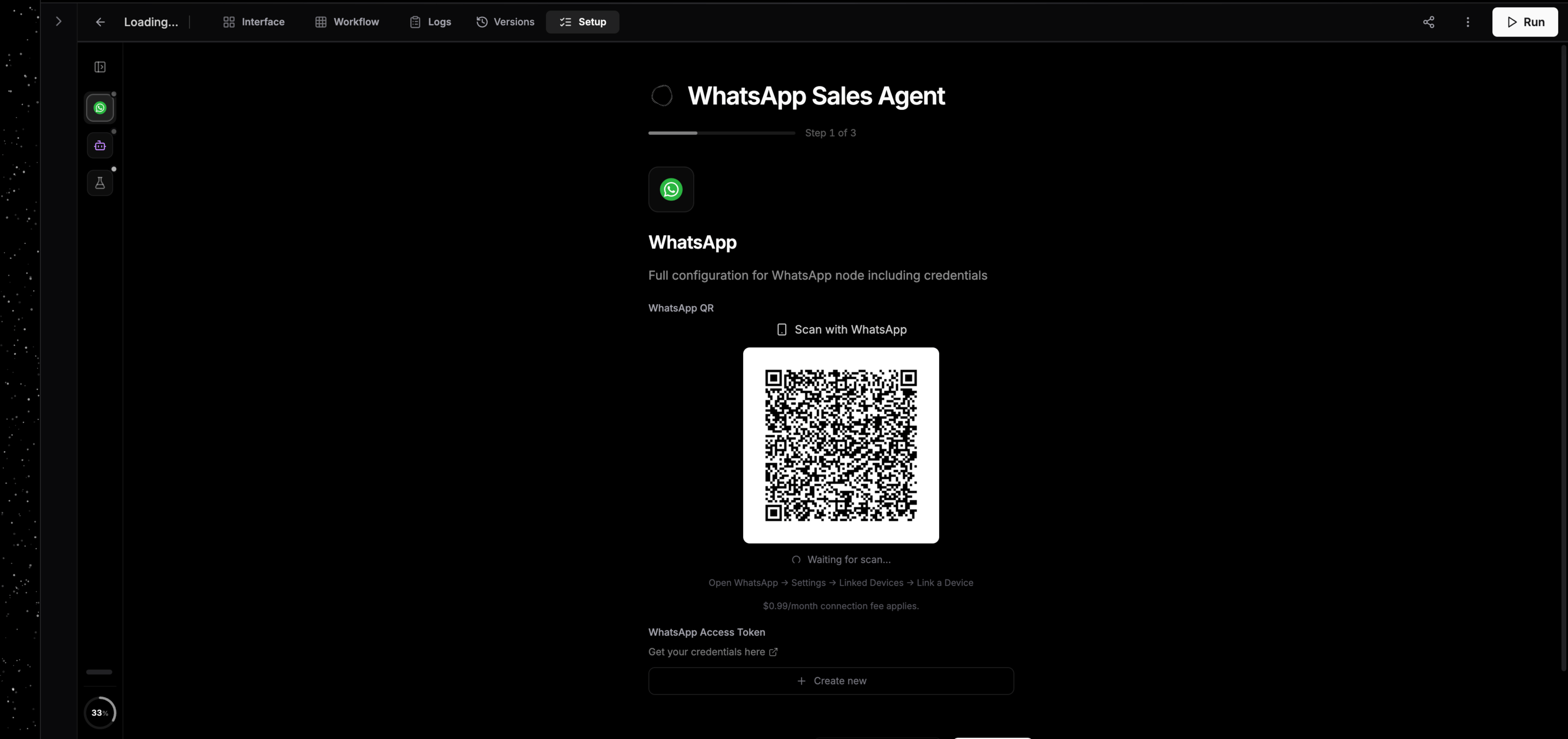
Setup with a WhatsApp credential step active
Which agent should run it
If the workflow has an agent node, Setup asks what it runs on. Platform managed runs on NoClick’s key and is ready with no account. The coding agent harnesses run on your own account, so this step shows what each one needs and whether it is already connected. See Models and harnesses.The finale
Setup ends on something worth doing rather than an empty checklist. For a workflow that hosts an MCP server, the last step is the connect step: numbered instructions for your coding agent, the command to run, and a live status panel that flips from waiting to Connected as soon as your client calls the server. See Create your own MCP server. For everything else, the last step is a Test Run: the agent handles a staged event while every tool call is answered with made-up data. You can run it before finishing the rest of setup, since nothing needs to be live for the simulation to work.The setup check
Above the Test Run, the finale reports where the workflow stands. It is checked against what has happened, not only against what is filled in, and each state is one of six:
Where an agent’s send tool is pinned to one recipient, the check names that recipient, so you can see who an alert would reach before one goes out. Refresh rechecks without reloading the page.
The check is careful about what it claims. A Test Run is simulated, so it is never evidence that anything works end to end, and a message the provider accepted is not proof it was delivered. Only a real input, recorded on a real run, counts as one.
A trigger registers only once the path it starts can run. While a credential, an agent’s instructions, or a required field is missing, the trigger is not presented as live. Fill in what is missing and the trigger registers itself the next time the workflow saves.
Skipping a step
Nothing here blocks you. A step you skip becomes a warning that names what breaks rather than a gate: an agent with no connected account still runs, it just cannot do the part that needed the account. The same warning appears in three places, and they always agree with each other: at the end of Setup, under To make this real on the Test Run screen, and above the agent’s chat box.Setup after a fork
Taking a copy of a template opens Setup full screen, which is the whole onboarding rather than a tab inside the canvas. Work through it and click the ✕ to drop into the normal workspace at any point. See Using templates.Next steps
Workflow variables
Declare the values Setup should ask for.
Test runs
Watch the agent work before anything is live.
Connecting credentials
How accounts get connected.
Running and testing
Run the whole workflow or a single node.